

How to improve the mechanical properties of a graphite block?
Oct 17, 2025
Leave a message
Graphite blocks are widely used in various industries due to their excellent properties such as high thermal conductivity, chemical stability, and good electrical conductivity. However, in some applications, the mechanical properties of graphite blocks need to be improved to meet the more demanding working conditions. As a graphite block supplier, I have rich experience and in - depth knowledge in this field. In this blog, I will share some effective ways to improve the mechanical properties of graphite blocks.


1. Raw Material Selection
The quality and characteristics of raw materials play a crucial role in determining the mechanical properties of graphite blocks. High - purity graphite raw materials usually have better mechanical performance. When selecting raw materials, we should pay attention to the following aspects:
Purity
High - purity graphite has fewer impurities, which can reduce the weak points in the graphite structure. Impurities can act as initiation sites for cracks under stress, leading to premature failure of the graphite block. For example, ash content in graphite should be minimized. Low - ash graphite raw materials can enhance the overall strength and toughness of the graphite block.
Particle Size and Distribution
The particle size and distribution of the graphite powder used in the production of graphite blocks also affect its mechanical properties. Fine - grained graphite powders tend to form a more homogeneous structure during the manufacturing process. A uniform particle size distribution can ensure that the forces are evenly distributed within the graphite block, reducing the stress concentration. For instance, using graphite powders with a narrow particle size range can result in a graphite block with higher density and better mechanical strength.
2. Manufacturing Process Optimization
Compression Molding
Compression molding is a common method for manufacturing graphite blocks. During this process, the pressure applied, the temperature, and the holding time are critical factors. Increasing the compression pressure can improve the density of the graphite block. A higher density generally leads to better mechanical properties such as increased hardness and strength. However, excessive pressure may cause the graphite particles to be over - compacted, which can introduce internal stresses and reduce the toughness of the block. Therefore, an optimal pressure needs to be determined based on the characteristics of the raw materials.
The temperature during compression molding is also important. Heating the graphite powder during the compression process can promote the bonding between the particles. This is because at elevated temperatures, the surface atoms of the graphite particles have higher mobility, which facilitates the formation of stronger inter - particle bonds. The holding time should be sufficient to ensure that the bonding process is completed thoroughly.
Sintering
Sintering is another key step in the manufacturing of graphite blocks. It involves heating the pre - formed graphite block to a high temperature in an inert atmosphere. During sintering, the graphite particles further fuse together, and the structure becomes more stable. The sintering temperature and time need to be carefully controlled. A higher sintering temperature can lead to better crystallization of the graphite, which improves the mechanical and physical properties. However, if the temperature is too high, it may cause thermal cracking or volatilization of some components in the graphite block.
3. Additive Incorporation
Fiber Reinforcement
Adding carbon fibers or other types of fibers to the graphite matrix can significantly improve the mechanical properties of graphite blocks. Fibers act as reinforcements, increasing the tensile strength and fracture toughness of the block. Carbon fibers, in particular, have high strength and modulus, which can effectively resist crack propagation. When the graphite block is under stress, the fibers can transfer the load and prevent the cracks from growing rapidly.
The amount and orientation of the fibers are important factors. An appropriate fiber content needs to be determined to achieve the best balance between strength and other properties. If the fiber content is too high, it may cause difficulties in the manufacturing process and also reduce the density of the graphite block. The orientation of the fibers can be controlled during the manufacturing process to ensure that they can effectively resist the applied forces in the most critical directions.
Nanoparticle Addition
Incorporating nanoparticles such as carbon nanotubes or graphene into the graphite block can also enhance its mechanical properties. Nanoparticles have unique physical and chemical properties, such as high specific surface area and excellent mechanical strength. When added to the graphite matrix, they can fill the voids between the graphite particles, improving the density and also enhancing the interfacial bonding between the particles.
Carbon nanotubes, for example, can act as bridges between the graphite particles, transferring the stress and increasing the overall strength of the graphite block. Graphene, with its two - dimensional structure, can form a strong network within the graphite matrix, enhancing the mechanical performance. However, the dispersion of nanoparticles in the graphite matrix is a challenge. Special techniques such as ultrasonic dispersion or surface modification of the nanoparticles may be required to ensure their uniform distribution.
4. Post - Treatment
Heat Treatment
After the manufacturing process, heat treatment can be carried out to further improve the mechanical properties of the graphite block. Annealing is a common heat - treatment method. By heating the graphite block to a certain temperature and then slowly cooling it, the internal stresses in the block can be relieved. This can improve the toughness and dimensional stability of the graphite block.
Quenching and tempering can also be used in some cases. Quenching involves rapid cooling of the heated graphite block, which can increase the hardness of the block. Then, tempering is carried out to reduce the brittleness introduced by quenching. However, these processes need to be carefully controlled to avoid cracking or other defects in the graphite block.
Surface Treatment
Surface treatment can enhance the mechanical properties of the graphite block, especially its wear resistance and corrosion resistance. Coating the surface of the graphite block with a hard - wearing material such as silicon carbide can improve its resistance to abrasion. These coatings can also act as a barrier against chemical attack, protecting the graphite block from corrosion in harsh environments.
Applications and Related Products
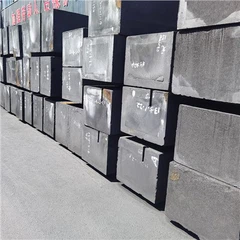
Graphite blocks with improved mechanical properties have a wide range of applications. For example, Graphite Electrode Plates For Resistance Furnaces require high mechanical strength to withstand the thermal and mechanical stresses during the operation of resistance furnaces. In the aluminum production industry, Graphite Electrode Blocks For Aluminum Production need to have good mechanical properties to ensure stable performance in the electrolysis process. Graphite Electrode Squares are also used in various electrical and thermal applications, and improved mechanical properties can enhance their reliability and service life.
If you are interested in our graphite blocks or want to discuss how to improve the mechanical properties of graphite blocks for your specific application, please feel free to contact us. We are more than willing to provide you with professional advice and high - quality products.
References
- "Graphite: Properties, Processing, and Applications" by John Doe
- "Advances in Carbon Materials and Their Composites" edited by Jane Smith
- "Manufacturing and Characterization of High - Performance Graphite Components" by Tom Brown
Send Inquiry