

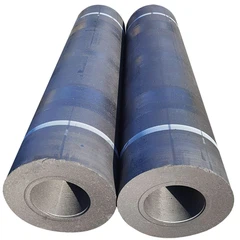
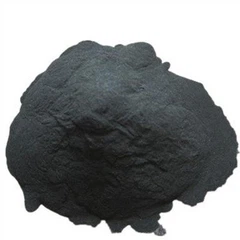
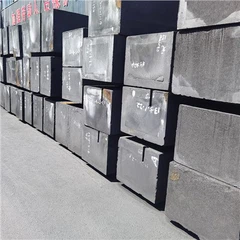
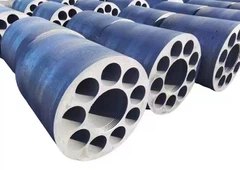

Graphite electrode production process flow chart
Sep 20, 2024
Leave a message
Graphite electrode production process flow chart
Raw materials: What are the raw materials used for carbon production?
In carbon production, the raw materials commonly used can be divided into two categories: solid carbon raw materials and binders and impregnants. Solid carbon raw materials include petroleum coke, asphalt coke, metallurgical coke, anthracite, natural graphite and graphite fragments; binders and impregnants include coal tar, coal tar, anthracene oil and synthetic resins. In addition, some auxiliary materials are also used in production, such as quartz sand, metallurgical coke particles and coke powder. Other special raw materials are used to produce some special carbon and graphite products (such as carbon fiber, activated carbon, pyrolytic carbon and pyrolytic graphite, glassy carbon).
Calcination: What is calcination? Which raw materials need to be calcined?
The process of high-temperature (1200-1500°C) heat treatment of carbon raw materials under air-tight conditions is called calcination. Calcination is the first heat treatment process in carbon production. Calcination causes a series of changes in the structure and physical and chemical properties of various carbon raw materials.
Anthracite and petroleum coke both contain a certain amount of volatile matter and need to be calcined. The coking temperature of pitch coke and metallurgical coke is relatively high (above 1000°C), which is equivalent to the temperature of the calcining furnace in the carbon plant. They do not need to be calcined, but only need to dry the moisture. However, if pitch coke and petroleum coke are mixed before calcination, they should be sent to the calcining furnace together with petroleum coke for calcination. Natural graphite and carbon black do not need to be calcined.
Pressing: What is the principle of extrusion molding?
The essence of the extrusion process is to make the paste pass through a certain shape of die under pressure, and then be compacted and plastically deformed to become a blank with a certain shape and size. The extrusion molding process is mainly the plastic deformation process of the paste.
The paste extrusion process is carried out in the material chamber (or paste cylinder) and the arc-shaped die. The hot paste loaded into the material chamber is pushed by the rear main plunger. The gas in the paste is forced to be continuously discharged, the paste is continuously dense, and the paste moves forward at the same time. When the paste moves in the cylindrical part of the material chamber, the paste can be regarded as a stable flow, and each particle layer basically moves in parallel. When the paste enters the extrusion nozzle with arc deformation, the paste close to the nozzle wall encounters greater friction resistance, the material layer begins to bend, and different advancement speeds are generated inside the paste. The inner layer of paste advances ahead, resulting in uneven density of the product along the radial direction. Therefore, internal stress caused by different flow rates of the inner and outer layers is generated in the extrusion block. Finally, the paste enters the linear deformation part and is extruded.
Baking: What is baking? What is the purpose of baking?
Baking is a heat treatment process in which the raw product after pressing is heated in a protective medium in a heating furnace under air-tight conditions at a certain heating rate.
The purpose of baking is:
(1) Eliminate volatiles. Products using coal tar as a binder generally emit about 10% of volatiles after baking. Therefore, the baking yield is generally below 90%.
(2) Binder coking The raw product is roasted under certain process conditions to coke the binder and form a coke network between the aggregate particles, firmly linking all aggregates of different particle sizes together, so that the product has certain physical and chemical properties. Under the same conditions, the higher the coking rate, the better the quality. Generally, the coking residual carbon rate of medium-temperature asphalt is about 50%.
(3) Fixed geometric form The raw product softens and the binder migrates during the roasting process. As the temperature rises, a coking network is formed, which makes the product rigid. Therefore, even if the temperature rises again, its shape does not change.
(4) Reducing resistivity During the roasting process, the resistivity drops significantly due to the removal of volatiles, the coking of asphalt to form a coke network, the decomposition and polymerization of asphalt, and the formation of a large hexagonal carbon ring plane network. The resistivity of the raw product is about 10000×10-6Ω·m, which drops to 40--50×10-6Ω·m after roasting, and is called a good conductor.
(5) Further volume shrinkage After roasting, the diameter of the product shrinks by about 1%, the length shrinks by about 2%, and the volume shrinks by 2-3%.
Impregnation: Why do carbon products need to be impregnated?
The porosity of the raw product after pressing is very low. However, after the raw product is roasted, part of the coal tar pitch decomposes into gas and escapes during the roasting process, while the other part is coked into asphalt coke. The volume of the generated asphalt coke is much smaller than the original volume of the coal tar pitch. Although it shrinks slightly during the roasting process, many irregular tiny pores with different pore sizes are still formed inside the product. For example, the total porosity of graphitized products is generally 25-32%, and the total porosity of carbon products is generally 16-25%. The presence of a large number of pores will inevitably have a certain impact on the physical and chemical properties of the product. Generally speaking, the porosity of graphitized products increases, their volume density decreases, their resistivity increases, their mechanical strength decreases, their oxidation rate accelerates at a certain temperature, their corrosion resistance also deteriorates, and they are more easily penetrated by gases and liquids.
Impregnation is a process that reduces the porosity of products, increases density, increases compressive strength, reduces the resistivity of finished products, and changes the physical and chemical properties of products.
Graphitization: What is graphitization? What is the purpose of graphitization?
Graphitization is a high-temperature heat treatment process in which the roasted products are placed in a protective medium in a graphitization furnace and heated to a high temperature, so that the hexagonal carbon atom plane grid is transformed from a disordered overlap in two-dimensional space to an ordered overlap in three-dimensional space, and has a graphite structure.
Its purpose is:
(1) Improve the thermal and electrical conductivity of the product.
(2) Improve the thermal shock resistance and chemical stability of the product.
(3) Improve the lubricity and wear resistance of the product.
(4) Remove impurities and improve product strength.
Machining: Why do carbon products need to be machined?
(1) The need for shaping
Carbon raw products with certain size and shape will be deformed and damaged to varying degrees during the roasting and graphitization process. At the same time, some fillers are also adhered to their surface. If they are not processed mechanically, they cannot be used. Therefore, the products must be shaped and processed into the specified geometric shape.
(2) The need for use
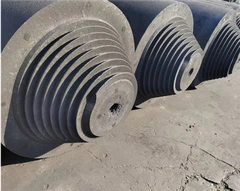
Processing is carried out according to the user's use requirements. For example, if the graphite electrodes for electric furnace steelmaking need to be connected for use, threaded holes must be machined at both ends of the product, and then the two electrodes must be connected with a special threaded joint for use.
(3) Processing needs
Some products need to be processed into special shapes and specifications according to the user's process needs, and even require a lower surface roughness.
Send Inquiry